MCPAMine Clearance Planning Agency

Afghan humanitarian mine actionSince 1990

Our work · Risk education

Explosive ordnance risk education

Clearance takes time. Until the land is clear, knowing what a mine or an unexploded shell looks like, and what to do on finding one, keeps people alive. MCPA has reached 888,824 people with risk education.

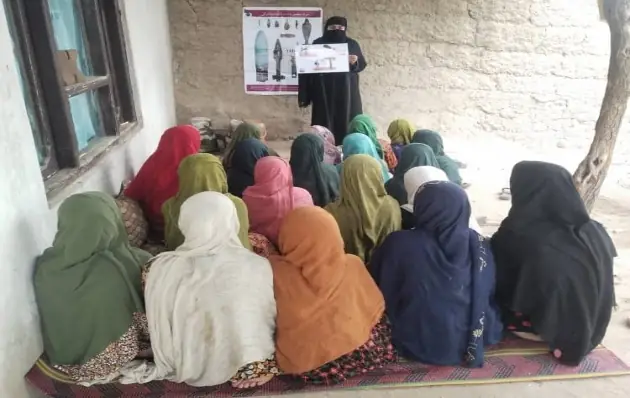
Seen from behind, a group of women in headscarves sit on the floor of a courtyard as a woman educator shows posters of explosive items.
A risk-education session for women, Mihtarlam, Laghman, 2025.

How it is delivered

Where people already gather, in their own language

Sessions are led by paired male and female teams, using materials approved by the Mine Action Programme of Afghanistan, in Dari and Pashto. They take place in schools, mosques, markets, community meetings and the centres where returning families arrive.

  • women trainers reach women and girls
  • pre-tests and post-tests measure what people have learned
  • data is disaggregated by sex, age and status
  • referral pathways connect survivors, children and persons with disabilities to support
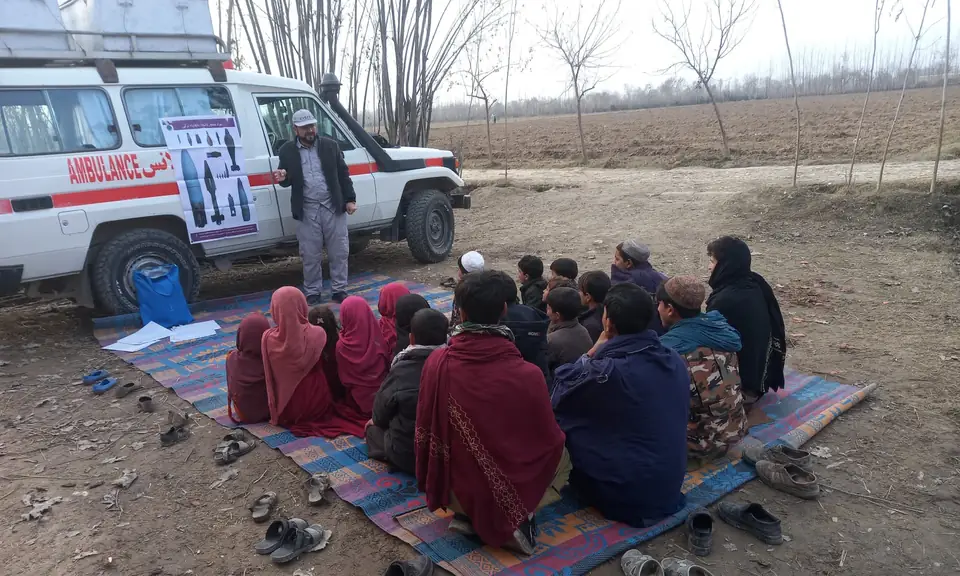
Children and adults sit on a patterned mat outdoors, facing an educator who stands beside an MCPA ambulance with a poster of explosive items.
A risk-education session in Baghlan, December 2024. MCPA field photograph.

Who it reaches

Returnees, children, farmers and scrap collectors

Families returning from Pakistan and Iran often do not know what years of conflict left in the ground around their homes. Children pick up unfamiliar objects, and people who collect scrap metal handle old ordnance for a living. Risk education is aimed at the people most likely to meet a hazard, and it is often delivered together with quick response and clearance.

What Mohammad Amin remembered

Beyond the minefield: two referrals

Questions

About risk education

What is explosive ordnance risk education (EORE)?

Explosive ordnance risk education teaches people to recognise mines and other explosive items, to avoid dangerous areas and objects, and to report what they find. It was formerly called mine risk education (MRE). Its aim is to change behaviour so that fewer people are killed or injured.

Does risk education work?

MCPA measures it: participants take a test before and after each session to show what they have learned. In 1989, mines and explosive remnants of war killed or injured an average of twenty people killed or injured every day in Afghanistan; with clearance, survey and risk education over the decades since, that toll has fallen to an average of about twenty a month.

What should I do if I find something that might be explosive?

Do not touch or move it. Mark the place if you can do so safely, keep people and animals away, and report it to the national mine-action hotline or to any mine-action team working nearby.

Can MCPA deliver risk education for our project or staff?

Yes. MCPA's outreach experience applies to staff, patients and communities around health, education and development sites. Contact our head office.
Working with MCPA: MCPA is accredited by the Directorate of Mine Action Coordination (DMAC). Contact our head office in Kabul.