
Risk education and child protection · Returnee areas · 2024 to 2025
Beyond the minefield: two referrals
Risk educators reach families that few other services do. In one AHF-funded project, MCPA used that reach to connect children with care: 305 were referred for protection services. Here are two of them.
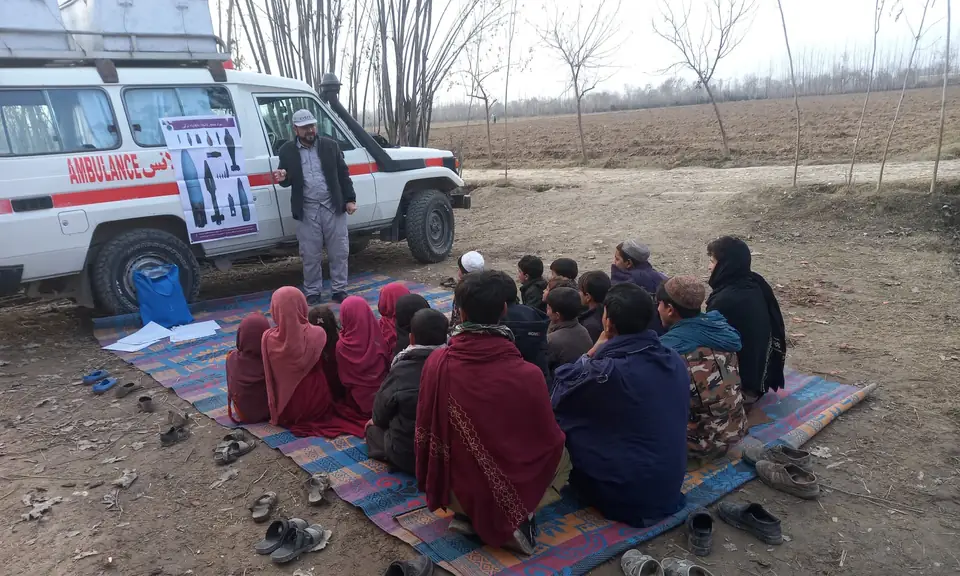
Families returning from Pakistan and Iran after decades of displacement often do not know the roads and villages they are coming back to, or the contamination in them. According to the Mine Action Programme of Afghanistan, more than 80 incidents had occurred recently, disproportionately affecting children.
The project combined quick response teams, which find and destroy explosive items, with risk-education teams. It added a child-protection component: identifying children affected by conflict, injury or trauma, and referring them to specialised medical and psychosocial services and charitable programmes.
- 3,832communities visited for non-technical survey
- 17,745,056 m²surveyed
- 110,213 m²of hazardous area cleared
- 101,281 m²cancelled
- 11,337explosive items destroyed
- 75,801people reached with risk education: 12,552 women, 22,721 girls, 15,407 men and 25,121 boys
- 305children referred for protection services
- 30,767villagers reached with child-protection messages
A smile, restored
In a village in Dasht-e Archi district, Kunduz, a ten-year-old boy had been born with a cleft lip and palate. It made it hard for him to speak clearly and to eat, and he was bullied at school. His parents did not know that treatment was possible, or that it could be had free of charge.
On 13 May 2025, an MCPA-trained risk-education team leader held a child-rights awareness session in the village, covering every child's right to health, education and freedom from discrimination, and the medical and psychosocial services available through referral. Afterwards the village's community leader, Mohammad Hassan, approached the team leader and described the boy's situation and his family's helplessness.
The team visited the family at home and made an initial assessment. On 25 May they referred the boy to the Saadat Charity Foundation for Human Community Hospital, which specialises in children with congenital conditions. Within a week he was registered in a cleft-surgery outreach programme. On 18 June he travelled to Kunduz city with his father and received free corrective surgery and follow-up care, including speech therapy.
He has since gone back to school, where, the team reports, his classmates welcomed him and his teachers support him. His family now encourage other parents in their community to claim their children's right to health care.
Two hands
An eight-year-old boy from Khwost wa Fring district, Baghlan, had moved with his family to Pul-e-Khumri to escape the fighting. His mother, herself educated, wanted her children to be safe and in school; his father works as a daily labourer.
The fighting reached Pul-e-Khumri too. On 1 September 2021, playing with friends, the boy found a mortar shell and handled it. It exploded, injuring his face and lips and destroying his hand; he underwent amputation at the Médecins Sans Frontières hospital in Kunduz.
When MCPA's team learned of his case, they offered to refer him for a prosthetic. His father was grateful but explained that the family could not even afford the fare to the clinic. The team referred the boy to the HDDO office in Baghlan, which provides prosthetic hands and legs, and covered the family's travel costs.
He received two prosthetic hands: one for daily use, which lets him hold pens, books and cups, and one designed to help him feel confident and less aware of his loss. According to the team, he can now manage everyday tasks with ease.
About this account
MCPA's case study names both children and their villages. Because they are children, and one has a visible medical condition, we have not published their names, their villages or their photographs. MCPA can add them if the families' informed consent for publication is confirmed.
Source
MCPA case study, "Safety for Returnees: Mitigating Explosive Ordnance Risks, Supporting Sustainable Resettlement, Enhancing Road Safety, and Strengthening Child Protection Mechanisms", AHF-funded project CBPF-AFG-24-R-NGO-28012. Project dates from MCPA's project register. Photograph: MCPA.