MCPAMine Clearance Planning Agency

Afghan humanitarian mine actionSince 1990

Our work · Survey

Mine survey: finding where the danger is, and where it is not

Before a single detector touches the ground, MCPA survey teams establish which land is really contaminated. Survey is the cheapest and fastest way to give land back: most suspected ground turns out to be safe, and can be returned without physical clearance.

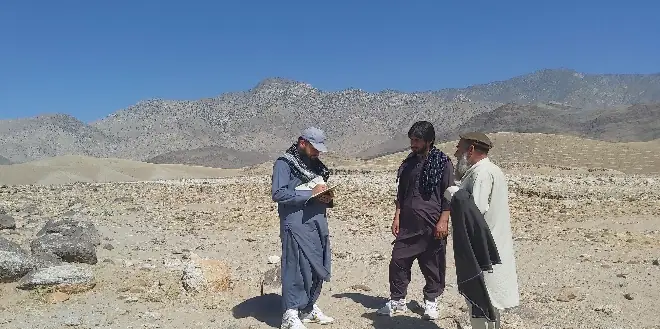
An MCPA surveyor with a clipboard talks with two local men on open ground below a mountain ridge.
Community liaison during survey, Laghman, 2025.

What MCPA surveys

Every kind of mine-action survey

  • Non-technical survey: gathering evidence from communities, records and accident data, and inspecting a suspected area without entering it
  • Technical survey: physical investigation that confirms whether hazards are present and fixes the exact edges of the confirmed hazardous area
  • Polygon survey: precise mapping of hazardous areas
  • General and landmine-impact survey: how contamination affects whole communities
  • Socio-economic impact studies, and mortality, injury and disability surveys

Teams work to documented standard operating procedures aligned with the Afghanistan Mine Action Standards and the International Mine Action Standards (IMAS).

The record

Survey has returned more land than clearance

Since 1990, MCPA survey teams have surveyed 157,017,549 m² of new hazardous area and re-surveyed a further 217,326,676 m². Survey has cancelled 178,052,539 m²: land given back to communities with no physical clearance needed, because the evidence showed it was safe. That is more than the 128,541,993 m² cleared and released.

The full record since 1990

Figures to May 2026, from MCPA's 2026 Organisational Profile. Sources

How survey works

It starts with the people who live there

Survey is built on community liaison: elders, shuras and community development councils, key-informant interviews, and focus-group discussions that include women. Local people know where fighting took place, where animals have been killed and which paths everyone avoids. Their knowledge, checked against records and accident data, secures acceptance and safe access before any physical work begins.

MCPA began in 1989 as a two-person cell set up to trial the survey techniques then being introduced in Afghanistan. It pioneered field-oriented minefield survey, and the survey once called General (Level One) Survey, now known as Non-Technical Survey, which later informed the UN-supported Global Landmine Survey. Its survey experience has also been used outside Afghanistan, in the Landmine Impact Survey in Yemen.

Recent work includes a US Department of State non-technical survey grant (June 2023 to May 2025) that deployed 18 survey teams and 8 quick response teams across 26 provinces at the same time, and UNDP's SESEHA programme, under which MCPA assessed 531 health and education facilities in nine provinces before solar systems were installed.

Before the solar panels, the surveyors

Questions

About mine survey

What is non-technical survey?

Non-technical survey collects and analyses information about a suspected area without physically entering it: interviews with the community, historical and accident records, and visual inspection from safe ground. It decides whether an area should be cancelled, investigated further or cleared.

What is technical survey?

Technical survey is a physical investigation inside a suspected area, using detectors, mechanical assets or other means, to confirm whether explosive hazards are present and to define the boundaries of the confirmed hazardous area, so that clearance covers only the ground that needs it.

What does "cancelled" land mean?

Land is cancelled when survey finds no evidence of explosive hazards. It is formally released back to its community without clearance. MCPA has cancelled 178,052,539 m² this way since 1990.

Can MCPA survey land before a construction or development project?

Yes. Roads, clinics, schools and power lines cannot be built safely on contaminated ground, and MCPA has surveyed project sites for partners including UNDP. Contact us to discuss a survey.

Need survey or clearance? MCPA is accredited by the Directorate of Mine Action Coordination (DMAC) and has worked in all 34 provinces. Contact our head office in Kabul.