MCPAMine Clearance Planning Agency

Afghan humanitarian mine actionSince 1990

Our work · Quick response

Quick response and explosive ordnance disposal

Not every hazard sits in a mapped minefield. A shell turns up in a field, a grenade in a scrap shop, old ammunition in a storeroom. MCPA's Quick Response Teams go where they are called, confirm the danger, and destroy it.

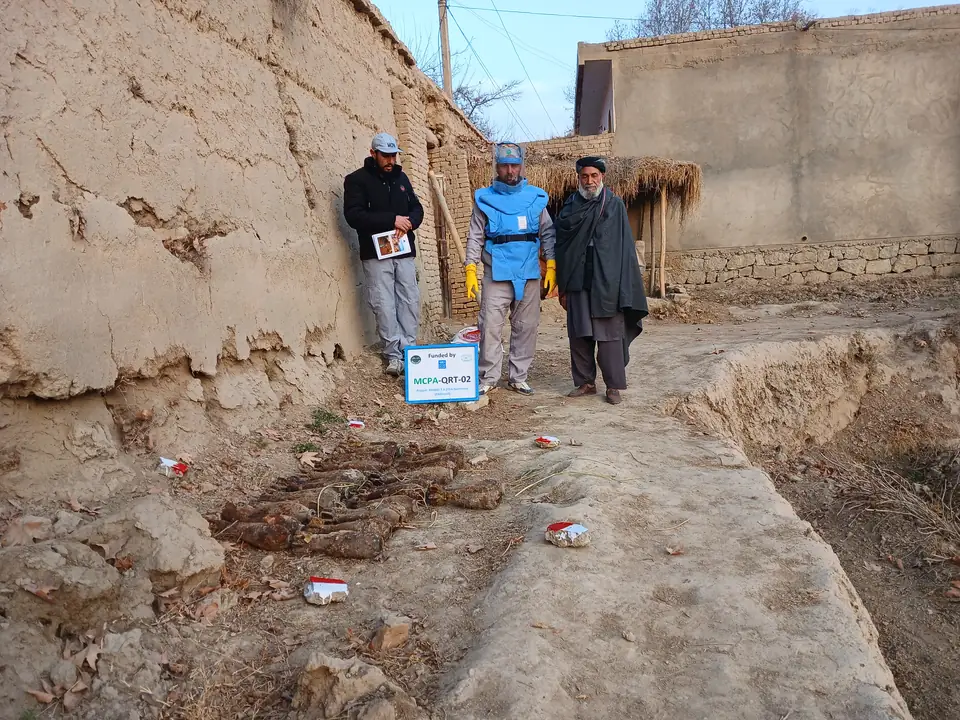
Three men, one in an MCPA protective vest, stand beside a mud wall; explosive items collected by the team lie on the ground in front of them.
Quick Response Team 2 answering a hotline call in Archi district, Kunduz, February 2026.

The team

One mobile team, from report to disposal

Each Quick Response Team combines survey, spot disposal and clearance in a single mobile team:

  • a team leader and a surveyor
  • an abandoned-improvised-mine (AIM) and explosive ordnance disposal (EOD) operator
  • a deminer and a medic
  • drivers and a guard

Teams respond to hazards reported through the national mine-action hotline or directly by communities: they verify the report, mark the danger, destroy what they find and, where needed, deliver risk education on the spot.
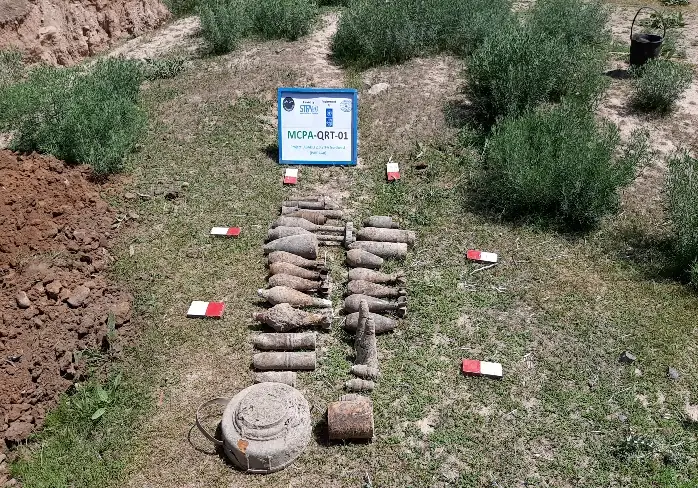
Shells and other explosive items laid out in rows on the ground beside an MCPA team sign, marked with red and white markers.
Items collected by a quick response team in Nahrin, Baghlan, before destruction.

At scale

Across 26 provinces at once

Under a US Department of State grant from June 2023 to May 2025, eight MCPA Quick Response Teams worked alongside 18 survey teams across 26 provinces at the same time. Quick response has also been combined with risk education and child-protection referrals in areas where many families are returning home.

The junk shop in Nahrin bazaar

The locked room

Questions

About quick response and EOD

What is explosive ordnance disposal (EOD)?

Explosive ordnance disposal is the detection, identification, rendering safe and destruction of explosive items such as mines, shells, grenades, rockets and improvised devices. MCPA has destroyed 266,480 items of explosive ordnance since 1990.

What should I do if I find something that might be explosive?

Do not touch or move it. Mark the place if you can do so safely, keep people and animals away, and report it to the national mine-action hotline or to any mine-action team working nearby.

Who sends a Quick Response Team?

Reports come through the national mine-action hotline and directly from communities. The team verifies the report, marks the hazard and destroys what it finds.

Working with MCPA: donors and partners can fund quick response capacity for a province or programme. Contact our head office in Kabul.