
Survey · Nine provinces · July 2024 to July 2025
Before the solar panels, the surveyors
A UNDP programme set out to bring solar power to 540 schools and health facilities. Before anyone could dig a foundation or lay a cable, someone had to establish whether the ground around each site was safe.
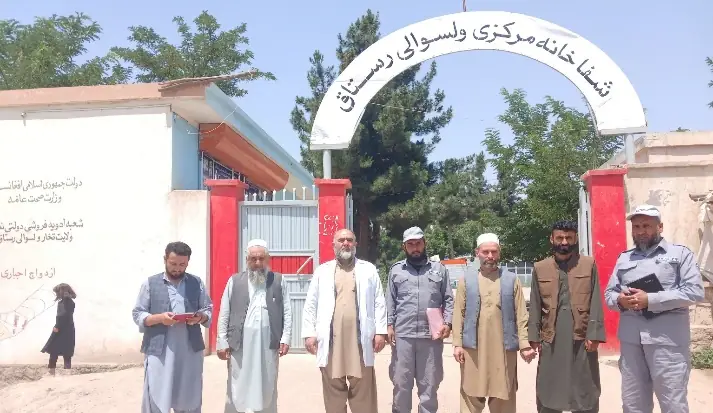
In Afghanistan, construction on unsurveyed ground is a risk to the workers who dig and to the patients, pupils and neighbours who will use the building. The SESEHA programme aimed to keep schools and clinics running by installing solar energy at 540 targeted sites. Before the engineers, UNDP sent for the surveyors.
MCPA deployed specialised non-technical survey teams to assess each site: interviewing staff, community members and local authorities, reviewing what was known about the area, and inspecting the ground. The teams coordinated throughout with UNDP, the Directorate of Mine Action Coordination, the Afghanistan National Disaster Management Authority, local authorities and communities.
Four hours of electricity
On 26 June 2025 the team visited the Central Hospital in Rustaq district, Takhar Province. Established in 1976 and supported by Aga Khan Health Services, it has 75 beds and serves more than 400,000 people from Rustaq and the surrounding districts, including Shahr-e-Bozorg in neighbouring Badakhshan Province. Its 51 staff include 22 male and 18 female doctors, and together they treat about 700 patients a day.
The hospital director, Dr. Sahib Farid Ahmad, described its most pressing problem: electricity is available only from 8 in the morning until noon. After that, surgery and other essential services depend on generators.
In Beshkand village, the principal of the Bibi Aisha Sediqa girls' school, Mr. Farukh Laqa, described the same shortage, affecting the school's administration, lighting, laboratory and hygiene systems. Similar interviews with principals, health workers and residents across the nine provinces told the same story, and raised hopes for the solar project.
Why the ground is checked first
On a tour of the hospital, the team met an elderly mother recovering from surgery. Her family had fled fighting in Imam Sahib district of Kunduz and settled in Rustaq. In their village, she said, unexploded ordnance lay among the ruins where children played.
One day her young son, a first-grade pupil, heard a scrap collector calling and ran to bring him an unexploded item. He dropped it near his father and three other villagers. The explosion killed all four men; the scrap collector was injured and died on the way to hospital. Her son survived with light injuries.
“They treated us with respect and said my son's survival was a blessing.”
A mother in Rustaq, describing the clearance team that later removed several mortar shells from the area. She asked not to be photographed.
What the survey found
- 540education and health sites targeted
- 431confirmed safe within a 1 km radius and approved for solar installation
- 1site found contaminated and reported to DMAC for clearance
- 9provinces
Figures as reported in MCPA's case study of 20 August 2025. MCPA's 2026 organisational profile records 531 facilities assessed across the nine provinces during Phase I.
For the one contaminated site, MCPA submitted a detailed Hazardous Area Report to DMAC so that clearance can be planned, and will monitor that work. For the rest, the survey removed a safety barrier to building: construction companies could send workers with confidence, and mine-action and development partners worked more closely together.
What is planned, not yet done
The solar systems themselves are installed in the next phase of SESEHA, by other partners. MCPA's role was to establish that the ground was safe. When the hospital in Rustaq can keep its operating theatre lit past noon without a generator, that will be the result of the installation; the survey made it possible to begin.
Source
MCPA case study, "UXO Non-Technical Survey (NTS) for Sustainable Energy Services for Education and Health in Afghanistan (SESEHA)", grant ref. UNDPAFGRRPA/2024/05/01, written by Omar Gul Muqbel, submitted 20 August 2025; MCPA Organisational Profile (2026). Photograph: MCPA Field Operation Unit.