
Clearance · Qerghez, Khanaqah and Imam Sahib villages · Imam Sahib district · Kunduz Province
Qerghez, after the mines
Improvised mines laid during the fighting had closed off homes, a mosque, roads and farmland in three villages of northern Kunduz. MCPA's team cleared them and handed the land back, and a farmer who had lost his leg on his own land told them what the mines had cost.
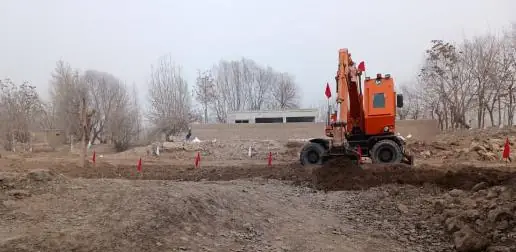
Imam Sahib district lies in the north of Kunduz Province, on the border with Tajikistan. With a population of 228,583, it is an agricultural centre on the trade route through the Shir Khan Bandar port. It has also been a place of heavy fighting, and it was left contaminated with explosive remnants of war and improvised explosive devices: the cause of civilian casualties and displacement, and a brake on recovery.
Between 2015 and mid-2021, according to reports gathered by the team, improvised anti-personnel and anti-vehicle mines were laid in these areas as the fighting moved across them.
Three villages, three kinds of blockage
- Qerghez: seven hazardous areas covering 36,140 m² blocked homes, roads and farmland. Nine homes could not be reached; 56 households, 450 people, were affected.
- Khanaqah: 2,198 m² of contamination blocked the village mosque, affecting 105 households.
- Imam Sahib village: 2,206 m² blocked three houses, affecting 31 households.
Din Mohammad
Din Mohammad is a 42-year-old farmer from Qerghez. He had lived through years of conflict and displacement, and when a period of relative calm came he returned home, intending to repair his house and restore the farm that had supported his family.
Walking through his own property, he stepped on an improvised anti-personnel mine. The explosion took his left leg. In an area where health services were scarce, the injury was not only life-changing but life-threatening.
Community elders raised his case with the team, and thanked MCPA for addressing the threat. He was interviewed by the team leader of MCPA-AIM-01. (A UNMAS monitoring team also visited an explosive-ordnance survivor in Qerghez together with MCPA's team.) His experience points to what survivors need beyond clearance: immediate medical care, long-term rehabilitation, psychological support and help rebuilding a livelihood.
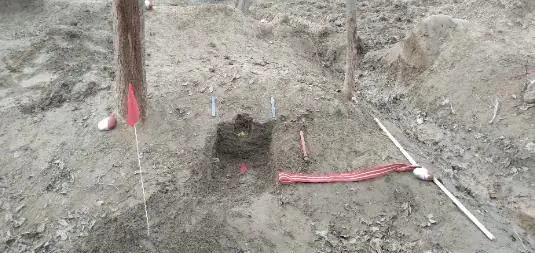
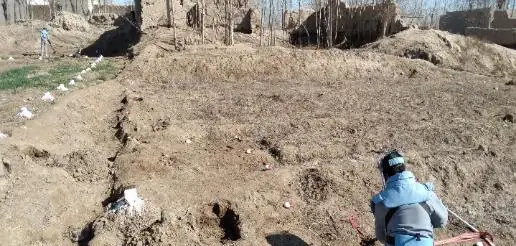
- 26,083 m²cleared and returned to the community
- 13,931 m²cancelled after fresh non-technical survey
- 19 + 3improvised mines and other explosive items destroyed
- 1,604people reached with risk education
- 13victims of explosive ordnance identified and their cases verified
After clearance
The cleared land was returned to its owners and communities. According to the team's report, residents can now reach their homes, schools and farmland without fear, and displaced families have been able to return.
What was still to be done
During the project, the team identified a hazardous area that was not in the original work plan, and MCPA asked for it to be added so that clearance could continue. The report anticipated that Imam Sahib district would then be declared free of known mined areas. We have not seen confirmation that this declaration has been made, and will update this page when MCPA confirms it.
Source
MCPA case study, "Abandoned Improvised Mines (AIM) and ERW clearance facilitated access to livelihoods and resettlement of conflict IDPs", OCHA-managed AHF project 26371 (CBPF-AFG-23-S-NGO-26371), prepared by Mohammad Ayaz, Team Leader, MCPA-AIM-01. Photographs: MCPA.